



Politics
One Nation's Surge Has Rewritten Australian Politics. Winning Government Is Another Question.
Polling has put Pauline Hanson's party ahead of the major parties on primary vote. But the evidence behind the surge shows a narrower story: immigration, Coalition collapse, distrust of government and a preference system still working against One Nation.
By B. O'Connell
10 September 2026 · 8 min read
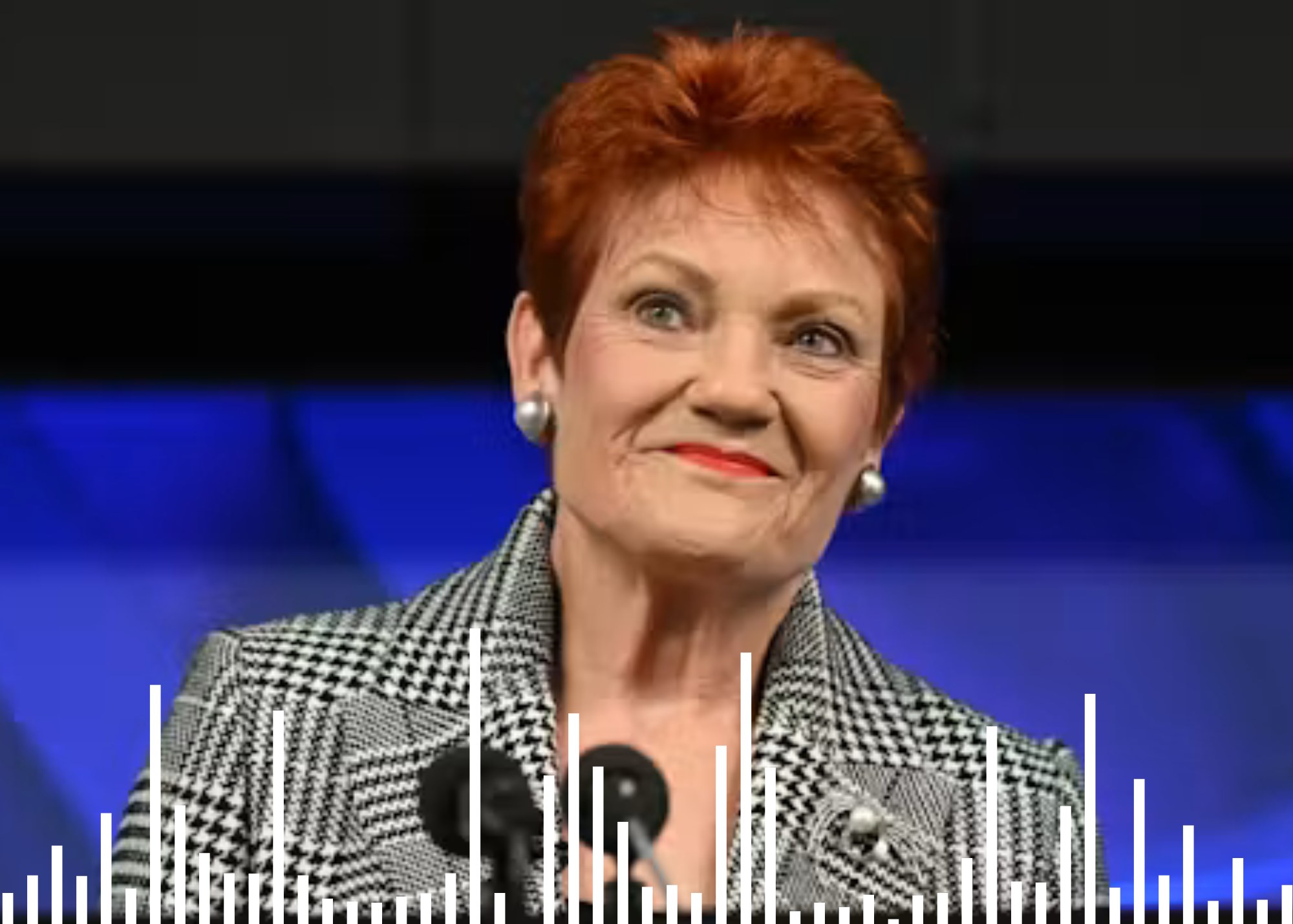
The first clue to Pauline Hanson's new political moment is not in a party room, a campaign launch or a Senate stunt. It is in the issue list. In Ipsos's July 2026 Issues Monitor, cost of living remained the dominant concern for Australian voters, named by 63 per cent. Housing was second, crime third and the economy fourth. Immigration, absent from the top five for years, returned in fifth place at 21 per cent and rising.
On the first four issues, voters still named Labor as the party most capable of managing them. On immigration, they named One Nation. That division explains both the party's breakthrough and its ceiling. Hanson's party has become a vessel for the issue voters increasingly want discussed, but it has not yet convinced most voters it can govern across the issues they rank higher.
The numbers are still extraordinary. At the May 2025 federal election, One Nation won 6.4 per cent of the national House of Representatives first-preference vote and picked up two additional Senate seats. A year later, Newspoll fieldwork conducted from 1 to 4 June 2026 put the party on 31 per cent, ahead of Labor and ahead of the Coalition. Roy Morgan and Resolve recorded the same broad shift, though at different levels., The precise peak varies by pollster; the political fact does not. A party long treated as a protest vehicle had moved into the first rank of federal polling.
But the same polling contained the warning. The published two-party estimates and head-to-head modelling still had Labor ahead. One Nation could lead on first preferences and lose after preferences because most voters were still choosing someone else first, and many of those preferences flowed against it. In other words, the party had become large enough to reorder politics, but not yet broad enough to win it.
This is the record of how that happened: a polling surge, a migration debate, a Coalition collapse, two defectors, an expanding parliamentary machine and a preference wall that still stands between One Nation and power.
The series
One Nation's primary vote, May 2025 election to August 2026
Newspoll drawn as a line; the other pollsters where the article cites them. Pollsters disagree on the level, not the direction.
Treat 31 per cent as one pollster's peak, not a consensus. Newspoll ran above Resolve in every comparable month of 2026.
Source: Australian Electoral Commission (election result); Newspoll, The Australian; Resolve, SMH and The Age; Roy Morgan; Essential, Guardian Australia; RedBridge. Fieldwork dates as published.
 NOFUF
The rise has three dated steps, and the pollsters agree on the steps if not on the height.
The first is late 2025. Newspoll had One Nation at 15 per cent in fieldwork from 27 to 30 October, already more than double its election result. On 24 November, Hanson wore a burqa into the Senate chamber after being refused leave to introduce a bill banning full-face coverings. The Senate suspended her for the day, and the next day passed a censure motion 55 votes to 5, moved by Penny Wong, condemning the act as intended to vilify and mock people on the basis of their religion, and barring her for seven consecutive sitting days, a penalty that ran into the February 2026 sittings and was among the harshest imposed on a senator in decades.
The second is 14 December 2025, when two gunmen killed fifteen people at a Hanukkah event at Bondi Beach in an attack police treated as terrorism. Newspoll's next fieldwork, 12 to 16 January, had One Nation on 22, up seven.
The third is 22 January 2026, when the Liberal and National parties formally split. Newspoll's February fieldwork had One Nation on 27. From there it moved between 24 and 31 through to August, when it sat at 30 in Newspoll, 28 in RedBridge, and 23 in both Roy Morgan and Essential.
That spread is not noise. Newspoll, now run by Pyxis, produced higher One Nation numbers than Resolve in every comparable month of 2026, sometimes by six or seven points. The Conversation's Adrian Beaumont has noted the house effect; Crikey has argued that the polling itself feeds the surge. Whatever the cause, a reader should treat "31 per cent" as one pollster's peak, not a consensus.
One Nation's House vote at federal elections, and the June 2026 Newspoll
National first-preference share. The party's previous peak was 8.43 per cent in 1998. A poll is not an election.
Source: Australian Electoral Commission, national House of Representatives first-preference results; Newspoll, 1 to 4 June 2026.
NOFUF
Who moved
The people who moved to One Nation in 2025 and 2026 came mostly from one place. DemosAU's national MRP of October and November 2025 found the swing concentrated among voters aged over 55, in regional and outer-metropolitan seats, without university degrees, and drawn primarily from the Coalition: roughly one in five 2025 Coalition voters, against about one in twenty Labor voters. "They are picking up a small portion of Labor voters," DemosAU's George Hasanakos said, "but primarily it's a shift amongst Coalition voters." Kevin Bonham estimated Labor's contribution at perhaps three points.
The ABC's analysis of pooled polling in February 2026 added that men were slightly more likely than women to support the party, that support was strongest among low-income earners with a second bump above $200,000, and that the education gap was the sharpest divide of all. RedBridge found the generational line in June: 10 per cent of voters aged 18 to 29, 30 per cent of those aged 30 to 45. Roy Morgan's weekly crosstabs put the peak in the 50 to 64 bracket.
The by-elections confirmed the direction. At Farrer on 9 May 2026, One Nation's David Farley won 39.5 per cent, up 32.9, as the Liberal vote fell 31 points to 12.4. He became the first One Nation candidate ever elected to the House of Representatives. At the South Australian election on 21 March, the party won 22.9 per cent statewide, four lower-house seats and three in the Legislative Council; the vote was high enough that the state's electoral commission declined to calculate a two-party figure. In August, the party took the WA state seat of Secret Harbour from Labor.
The platform against the list
One Nation's published platform, as stated on its website and in Hanson's Senate speeches, rests on five positions. Net overseas migration cut to 130,000 a year, against a 2025 outcome of 301,000 and a government target of 225,000. Repeal of the legislated net zero target, withdrawal from the Paris Agreement, three new coal-fired power stations, a nuclear reactor in regional NSW, a ban on offshore wind and a 15 per cent domestic gas reserve. Housing demand addressed through the migration cap, restrictions on foreign ownership and a five-year GST pause on building materials. A ban on full-face coverings, tighter citizenship rules and an end to what the party calls multiculturalism in favour of a single national culture. Income splitting for families, tax brackets indexed to inflation, and defence spending at 3.5 per cent of GDP.
What voters say matters most, and who they trust to handle it
Share naming each issue among the most important, and the party seen as most capable on it
Immigration is back in the top five for the first time since March 2019, and it is the one issue on which voters name One Nation.
Source: Ipsos Australia Issues Monitor, July 2026, salience and party-most-capable measures. Housing, crime and economy shares are approximate readings of the same series.
NOFUF
Set against the Ipsos list, the fit is partial and specific. Immigration, the party's signature issue, is the one where voters name One Nation as the most capable party, and it is the issue whose salience is rising fastest. Cost of living and housing, the two issues that dominate the list, are addressed in the platform indirectly, through energy prices and through migration's effect on demand, but on both of them voters still name Labor as most capable. On climate and energy, the party's position runs against the majority view in every published survey.
The party's own figures on its central policy were not consistent. In August 2026, One Nation MPs gave migration targets in public that differed from the platform's 130,000 and from each other; David Farley suggested a figure up to 100,000 higher. The party's stated policy is the website's; the article records the discrepancy because the party's own people created it.
What they think of her
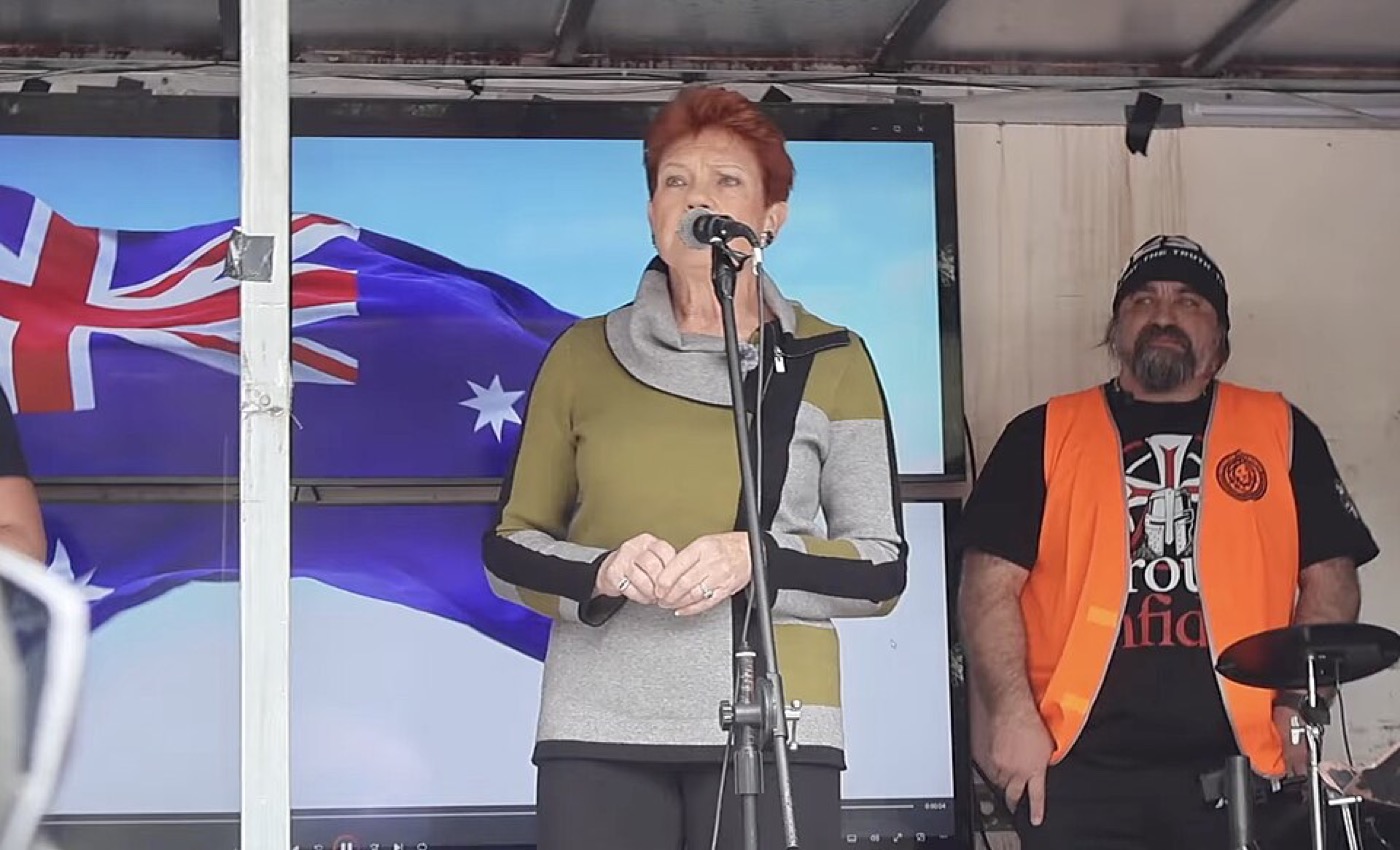
Newspoll asked about Hanson personally for the first time in June 2026. Forty-six per cent were satisfied with her performance and 49 per cent dissatisfied, a net of minus three; a later Newspoll had her level at 47 to 47. Freshwater had her net favourability at plus six early in the year, ahead of Anthony Albanese on minus nine. RedBridge had her at minus ten in June, still ahead of Albanese on minus eighteen. Asked to choose a preferred prime minister among three, Newspoll respondents picked Albanese 49, Hanson 31, Angus Taylor 20; with Taylor removed, Albanese led Hanson 57 to 43.
The Australian Election Study, the academic survey run after each election, found One Nation voters in 2025 the most distrustful of government of any group: 74 per cent believed those in government usually look after themselves, against a range of 24 to 48 per cent for every other party's voters. The ANU's Ian McAllister, a co-author of the study, described the younger end of the party's support as defined by education rather than age: young people without qualifications moving to One Nation, young people with them moving to the Greens. The ANUpoll in May 2026 characterised the support as potentially "more durable and structurally grounded" than a protest, resting on low hope, financial stress and scepticism about government capacity.
The money and the machine
One Nation's annual return to the Australian Electoral Commission for 2024-25 shows total receipts of $3,323,609 and payments of $3,326,298, with debts of $740,532. Itemised receipts above the disclosure threshold totalled $698,546; about $2.6 million, close to 80 per cent, came from sources below the threshold and is not disclosed, which the law permits. No donation from Gina Rinehart or Hancock Prospecting appears in the return. The party has never published a reliable membership figure.
The party has four senators: Hanson and Malcolm Roberts in Queensland, Sean Bell in NSW, who filled Warwick Stacey's casual vacancy in September 2025, and Tyron Whitten in WA, whose eligibility under section 44 of the Constitution was questioned by a constitutional expert in June 2026 and remains unresolved. In the House it has Barnaby Joyce, who joined on 8 December 2025 and will lead the NSW Senate ticket in 2028, and Farley. James Ashby, Hanson's chief of staff since 2016 and the man filmed by Al Jazeera in 2019 seeking money from the National Rifle Association, became the party's national director on 3 August 2026.,
First on primaries, second after preferences
Newspoll, June 2026. The two-party estimate is the one that decides elections.
Source: Newspoll, 1 to 4 June 2026, primary vote and two-party-preferred estimate, Labor against One Nation.
NOFUF
The number that decides
The preference flow is the whole story, and it should be stated as plainly as the primary vote. On the June Newspoll, 31 per cent of voters put One Nation first. Sixty-nine per cent did not, and the preferences of that 69 per cent, when distributed, produced a Labor lead of about six points. A primary-vote lead has not, in any published poll in 2026, become a two-party lead. In 1998, when the party won 22.7 per cent in Queensland and took eleven seats, it did so at a state election with different preference rules and a different opponent. The federal system since then has been designed, by both major parties, to make that outcome harder.
What would change the picture is a matter of record too. A sustained two-party estimate inside 51 to 49. A Newspoll approval rating for Hanson above water. A lower-house seat won at a general election rather than a by-election. None of those had happened by September 2026. The next election is not due until 2028.
The party that voters trust most on the fifth issue is, on the record, the party most voters will not put first. Both of those things are true at once. That is the year One Nation has had.
Do you have information about this matter? NOFUF welcomes documents, records and first-hand accounts that may assist its reporting. All information and source identities will be treated as confidential.
Right of reply
One Nation's figures are quoted from its published statements and its MPs' public remarks. No right of reply was sought.
Sources20
- Australia Issues Monitor, July 2026, issue salience and party most capable. Ipsos Australia, 1 July 2026.
- 2025 federal election, national House of Representatives first-preference results. Australian Electoral Commission, 3 May 2025.
- Newspoll, fieldwork 1 to 4 June 2026, primary vote, two-party estimate and satisfaction with Pauline Hanson. The Australian, Pyxis, 5 June 2026.
- Roy Morgan federal voting intention, June 2026 and August 2026. Roy Morgan, 1 August 2026.
- Resolve Political Monitor, 2026 series. Resolve Strategic for The Sydney Morning Herald and The Age, 1 June 2026.
- Newspoll, fieldwork 27 to 30 October 2025, 12 to 16 January 2026 and February 2026. The Australian, Pyxis, 1 February 2026.
- Senate Journals and Hansard, 24 and 25 November 2025, suspension and censure of Senator Hanson, division 55 to 5. Parliament of Australia, 25 November 2025.
- RedBridge and Essential federal polling, August 2026; RedBridge favourability, June 2026. RedBridge Group; Essential Research for Guardian Australia, 1 August 2026.
- Adrian Beaumont on house effects in One Nation polling; Crikey on polling and the surge. The Conversation; Crikey, 1 July 2026.
- National MRP, October and November 2025, and statement by George Hasanakos. DemosAU, 30 November 2025.
- Analysis of pooled polling on One Nation support, February 2026; Kevin Bonham's estimate of the Labor contribution. ABC News; Kevin Bonham, 15 February 2026.
- Farrer by-election, 9 May 2026, results. Australian Electoral Commission, 9 May 2026.
- South Australian state election, 21 March 2026, results; Secret Harbour by-election, August 2026. Electoral Commission of South Australia; Western Australian Electoral Commission, 1 August 2026.
- One Nation policy platform as published; Senate speeches of Senator Hanson; migration statements by One Nation MPs, August 2026. Pauline Hanson's One Nation, 31 August 2026.
- Freshwater Strategy favourability, early 2026. Freshwater Strategy, 1 February 2026.
- Australian Election Study 2025, trust in government by party vote; statement by Ian McAllister; ANUpoll, May 2026. Australian National University, 1 May 2026.
- Annual return 2024-25, Pauline Hanson's One Nation, receipts, payments and debts. Australian Electoral Commission, Transparency Register, 1 February 2026.
- Senate casual vacancy, NSW, September 2025; section 44 question on Senator Whitten, June 2026; Barnaby Joyce joins One Nation, 8 December 2025; James Ashby appointed national director, 3 August 2026. Parliament of Australia; One Nation, 3 August 2026.
- How to sell a massacre, National Rifle Association meetings with James Ashby. Al Jazeera, 26 March 2019.
- Queensland state election 1998 results. Electoral Commission of Queensland, 13 June 1998.
Disclosure
None.
More on Politics
- Grace Tame's Apology
10 September 2026