



Explainers
Defamation in Victoria: Why the Ten-Year Jail Threat Is Mostly a Distraction
Victoria still carries a ten-year maximum for criminal defamation. In practice, the real danger is usually civil: a concerns notice, a public judgment, a costs order and, for defendants who misjudge the risk, financial ruin.
Criminal defamation carries up to ten years in Victoria and is almost never prosecuted. The civil process is what happens: a serious-harm test, a compulsory concerns notice, a one-year clock, capped damages and uncapped costs. This is how it works, and what to keep if it is happening to you.
By B. O'Connell
31 August 2026 · 6 min read
The arresting number is ten years. It appears in Victoria's Crimes Act 1958, where criminal defamation is listed as a common-law offence carrying level 5 imprisonment, a maximum of 10 years. The same schedule places it beside bribery of a public official and misconduct in public office. The Wrongs Act 1958 separately preserves older statutory forms of criminal libel, including knowingly publishing a false defamatory libel, malicious publication, and publication or threatened publication for extortion.
Those provisions are not historical curiosities. They remain on the books and, in theory, can be enforced. But they are a poor guide to what usually happens when one Victorian defames another. Criminal defamation prosecutions are rare. They require a public prosecutorial decision, criminal proof beyond reasonable doubt and, in practical terms, evidence of bad faith or knowledge of falsity. The person who says a defamatory post will automatically lead to prison is describing the outer edge of the statute, not the ordinary legal reality.
The ordinary legal reality is civil litigation. It is slower than a police charge, more technical than an online argument and, for a defendant who refuses to correct a serious falsehood, often more financially destructive than any realistic sentence.
The civil machine
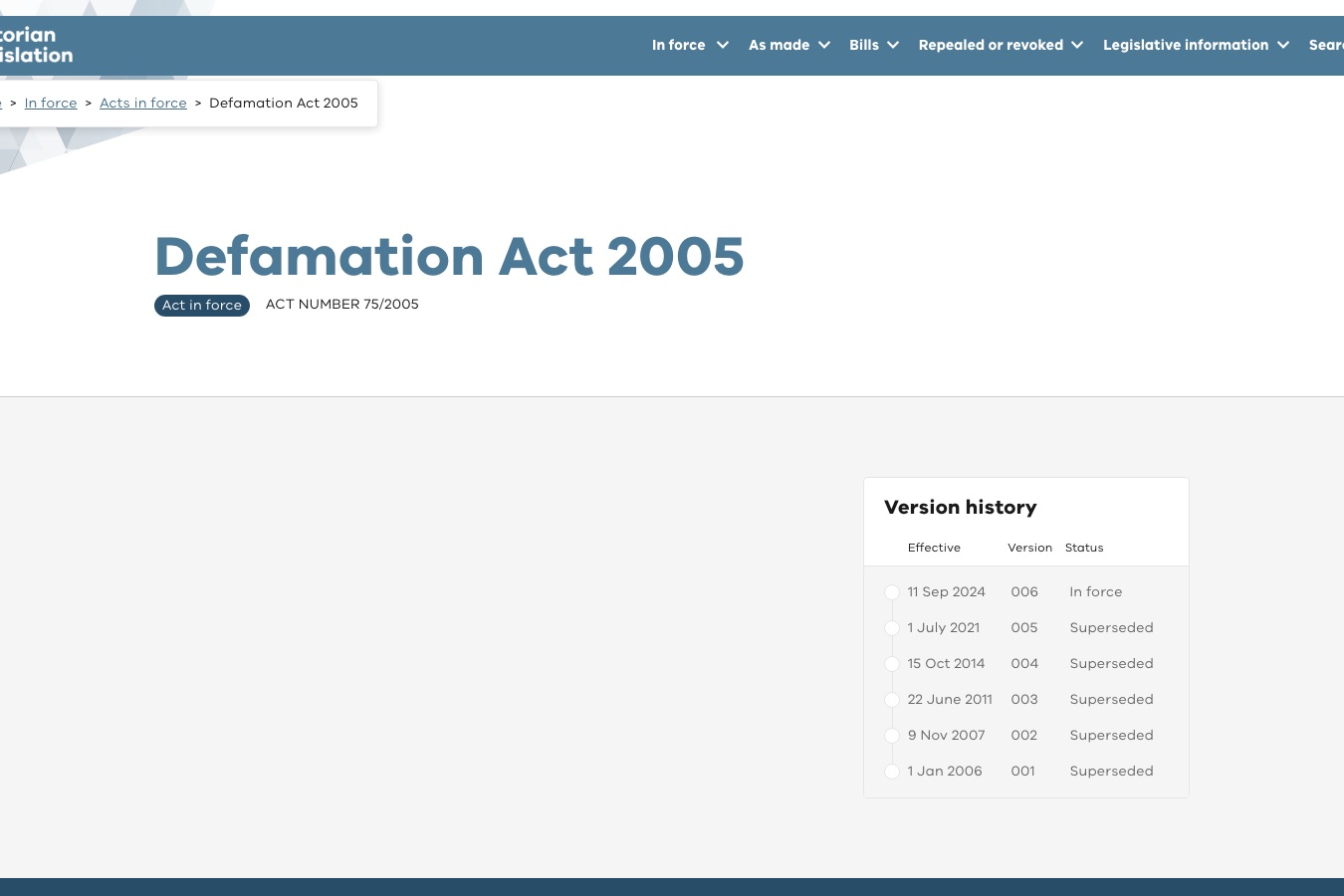
Victoria's civil defamation law has been reshaped twice in recent years. Stage 1 reforms commenced on 1 July 2021 and introduced the serious-harm threshold, a strengthened concerns-notice regime and a public-interest defence. Stage 2 reforms commenced in Victoria on 11 September 2024 and dealt with online intermediaries and related digital publication issues. Together, they define the modern pathway for most defamation disputes in the state.
Serious harm. Since 2021, a plaintiff must show the publication has caused, or is likely to cause, serious harm to their reputation. For an excluded corporation, the test is serious financial loss. This change matters because it ended the old assumption that defamatory words automatically produced actionable damage. A court can determine serious harm early and, if the threshold is not met, dispose of the case before the parties spend years fighting over meaning and defences. It is a filter against trivial claims, not a shield for serious ones.
The concerns notice. A plaintiff cannot start defamation proceedings in Victoria without first giving the publisher a concerns notice. The notice must identify the location of the publication, the defamatory imputations said to arise and the harm said to be serious. It can require precision down to the URL. Once a valid notice is served, the publisher has 28 days to respond, including by making an offer to make amends. A vague complaint that someone has been "defamed" is not enough.
This is where many disputes are won or lost. A publisher who acts quickly can offer a correction, apology, takedown, compensation or some combination of those steps. If a reasonable offer is refused and the matter later reaches court, the refusal can have serious consequences, including on costs. The concerns notice is therefore not a procedural courtesy. It is often the decisive moment.
The clock. The usual limitation period is one year from first publication. For online material, the single-publication rule means time generally starts when the matter is first uploaded, not every time it is later clicked, shared or read. A court can extend time to a maximum of three years if it was not reasonable to sue within the first year, but that is discretionary. Delay can kill an otherwise serious claim.
The public-interest defence. Section 29A protects publication on a matter of public interest where the publisher reasonably believed publication was in the public interest. The defence is built for responsible reporting, not abuse. Courts can examine the seriousness of the allegation, the reliability of sources, steps taken to verify the material and whether the subject was given a chance to respond. It is the legal architecture behind careful journalism; it does not rescue a reckless post dressed up as "public interest".
Damages. Damages for non-economic loss are capped and indexed annually. From 1 July 2026, public legal commentary records the cap at about $520,000. The cap does not limit proven economic loss, and aggravated damages can be awarded separately where the publisher's conduct makes the harm worse. Even so, in many cases the most punishing number is not damages. It is legal costs.
What it costs
A contested defamation proceeding in the County Court or Supreme Court of Victoria can cost each side six figures before judgment. The losing party will usually face an order to pay a substantial proportion of the winner's costs as well as their own. Those orders are enforceable like other civil judgments. They can attach to bank accounts, wages and property. If the debt is large enough and remains unpaid, bankruptcy is possible.
That is the penalty most defendants should fear: not the theoretical ten-year maximum, but a public finding that a specific allegation was false and damaging, followed by a costs bill that may outlast the dispute that caused it.
The 2024 changes, for people on social media
The 2024 reforms matter most when the defamatory material is online and the person who posted it is not the only actor involved. The law now gives digital intermediaries, including platforms and hosts, clearer incentives to deal quickly with properly framed complaints.
First, there is a seven-day removal pathway for digital intermediaries. A platform, forum or host can have a defence for third-party content if it maintains an accessible complaints mechanism and, after receiving a written complaint that meets the statutory requirements, takes reasonable steps to remove or block access to the content within seven days. The details matter. A generic report through an app may not be enough. A compliant complaint should identify the content, the imputations and why they are defamatory.
Second, courts can make access-prevention orders against digital intermediaries that were not parties to the original proceeding. In practical terms, a plaintiff may sue the person who published the allegation and later obtain an order requiring a platform or search provider to prevent access to the material, if the statutory conditions are met.
If it is happening to you
Evidence decides these cases, and online evidence is fragile. Posts are edited, deleted, hidden or moved once the author realises they matter. The first task is preservation, not retaliation.
The URL. Copy the exact address. It identifies the post, the account and the platform, and it is needed for a concerns notice, a platform complaint or a court order. A URL does not prove everything, but without it the trail can go cold quickly.
A capture with a visible date. For text or images, take a full-screen screenshot showing the platform timestamp, account name and, if possible, the system clock. For video, record the full video playing through with the account and timestamp visible. Save originals and avoid cropping, annotating or compressing the files.
An independent archive. Where lawful and technically possible, capture the page through an independent archive service at the time. A third-party timestamp can be harder to dispute than a private screenshot.
The audience. Preserve view counts, comments, shares and reactions. Serious harm is not proved by outrage alone. It is proved by showing who saw the material, how far it travelled and what effect it had.
Witnesses. Record the names and contact details of people who saw the publication and can say when and where they saw it. Publication means communication to at least one third party. A witness to that communication can matter more than a screenshot.
Then get advice before sending the concerns notice. A defective notice can waste time, narrow the wrong issue or give the publisher an avoidable tactical advantage. In a one-year limitation period, lost time is not administrative inconvenience. It is legal risk.
The other side of the same law
The same framework binds publishers. In law, a person posting to a social platform is not just "having their say". They are publishing. The serious-harm test protects against trivial claims. The public-interest defence protects careful reporting on matters that genuinely matter. The offer-to-make-amends regime rewards prompt correction. None of those protections is designed for a person who publishes a serious false imputation about an identifiable person, ignores a properly framed complaint and leaves the material online.
For that publisher, the ten-year figure is mostly a distraction. The more probable sentence is civil: a judgment, a costs order, a permanent public record and, in the worst cases, insolvency.
Do you have information about this matter? NOFUF welcomes documents, records and first-hand accounts that may assist its reporting. All information and source identities will be treated as confidential.
Right of reply
No individual is the subject of this explainer, so no right of reply was sought.
Sources5
- Crimes Act 1958 (Vic), section 320, maximum penalties for common law offences. Parliament of Victoria.
- Wrongs Act 1958 (Vic), sections 9 and 10, criminal libel. Parliament of Victoria.
- Defamation Act 2005 (Vic), sections 10A, 12B, 14, 29A, 31A, 35 and 39A. Parliament of Victoria.
- Limitation of Actions Act 1958 (Vic), sections 5(1AAA) and 23B. Parliament of Victoria.
- Defamation reforms, Stage 1 commencement 1 July 2021 and Stage 2 commencement 11 September 2024. Department of Justice and Community Safety, Victoria.
Disclosure
None.
More on Explainers
- 100,000 Businesses Must Watch Your Money
11 September 2026
- One Nation's Surge Has Rewritten Australian Politics. Winning Government Is Another Question.
10 September 2026
- The Dubai Scam Bust
10 September 2026
- Is Sydney's Gangland Violence Out of Control?
9 September 2026