


Crime
Is Sydney's Gangland Violence Out of Control?
Official crime data says murder in NSW is statistically stable. Police and media records tell a more disturbing story: a gangland conflict in which the wrong people are increasingly being killed.
By T. Nguyen
9 September 2026 · 10 min read
It took less than forty-eight hours for Sydney's gangland war to produce two men police believe were not the intended targets. First came Marco Tapia, 23, a university student shot dead in his bed at Glen Alpine while his family slept nearby. The next afternoon Joshua Macdonald, 40, an electrician, was shot in the head outside a Merrylands West home after arriving with another man and two children. Police said neither man appeared to have underworld links. By the following day, the state's political leaders were being asked whether organised crime in Sydney had slipped beyond control.
NSW Police Minister Yasmin Catley rejected the premise. "I do not accept that this is out of control," she said, adding that the state would not "surrender our streets to organised crime gangs". Acting Premier Prue Car said police were "on top of this". Senior police said they could suppress the violence. Opposition Leader Kellie Sloane said the opposite: "This is out of control."
The argument turns on which record is being read. The NSW Bureau of Crime Statistics and Research counts murder and classifies long-term trends. Police count operations, arrests, charges and shootings. Journalists compile the names of alleged gangland victims from police statements and court records. Each record is useful. None, on its own, answers the public question now hanging over Sydney: whether the state is containing organised crime, or merely counting the bodies after it misses.
The questions the record can answer are narrower than the ones being shouted. Is homicide rising in NSW? Are organised-crime killings rising? Are the people being killed the people who were meant to be killed? Is the pattern new? And what, in Victoria, is the equivalent of a minister saying "not out of control," when the numbers there are not in dispute?
What "stable" means
BOCSAR's most recent quarterly report, covering the twelve months to March 2026, records 87 murder victims in NSW, up from 80 the year before. It classifies the trend, over two years and over ten, as "stable."
That word is doing precise work and it should not be read as reassurance. BOCSAR tests each offence series with a rank-order correlation and reports a trend only when the movement is statistically significant. "Stable" means the movement did not meet that threshold. It does not mean the number did not move.
The number moved. In calendar 2024 NSW recorded 85 murder victims, the highest annual total since 2014, and a 46.5 per cent rise on the 58 recorded in 2023. BOCSAR's executive director, Jackie Fitzgerald, attributed the jump to "an unusually high number of events involving multiple murder victims," with the Westfield Bondi Junction attack of April 2024 accounting for six of them. The twelve months to March 2026 sit higher still, at 87. The bureau is correct that the series has fluctuated within a range for a decade. It is also the case that the top of that range is where NSW now is.
NSW murder victims, twelve months to March
Victims recorded by the Bureau of Crime Statistics and Research in each year to March, 2017 to 2026
BOCSAR classifies the two-year and ten-year trend as stable, meaning the movement is not statistically significant. Calendar 2024, at 85, was the highest annual total since 2014.
Source: NSW Bureau of Crime Statistics and Research, Recorded Crime Statistics quarterly reports to March 2026.
 NOFUF
Two other events inside the period should be counted and then set aside. On 14 December 2025, two gunmen killed 15 people at a Hanukkah gathering at Bondi Beach in an attack police treat as terrorism. On 22 January 2026, a man killed four people, including an unborn child, in what police believe was a domestic shooting spree at Lake Cargelligo. Both are shootings in NSW in the period. Neither is organised crime. Any count that folds them into the gangland figure inflates it by nineteen, and this article does not.
The killings the bureau cannot see
The dispute at the lectern was never about aggregate murder. It was about a specific kind of killing that BOCSAR's categories are not built to isolate: the contract shooting, ordered by someone offshore, carried out by someone young, at an address that may or may not be the right one.
BOCSAR has no "shooting" category. The nearest firearm offence in its quarterly table, robbery with a firearm, recorded 93 incidents in the year to March 2026, unchanged. Public-place shootings are counted by NSW Police and released through the media, not through the bureau. Nine News put the 2026 total at 51 by 2 September. That is a media tally of police information and it is the only single number there is.
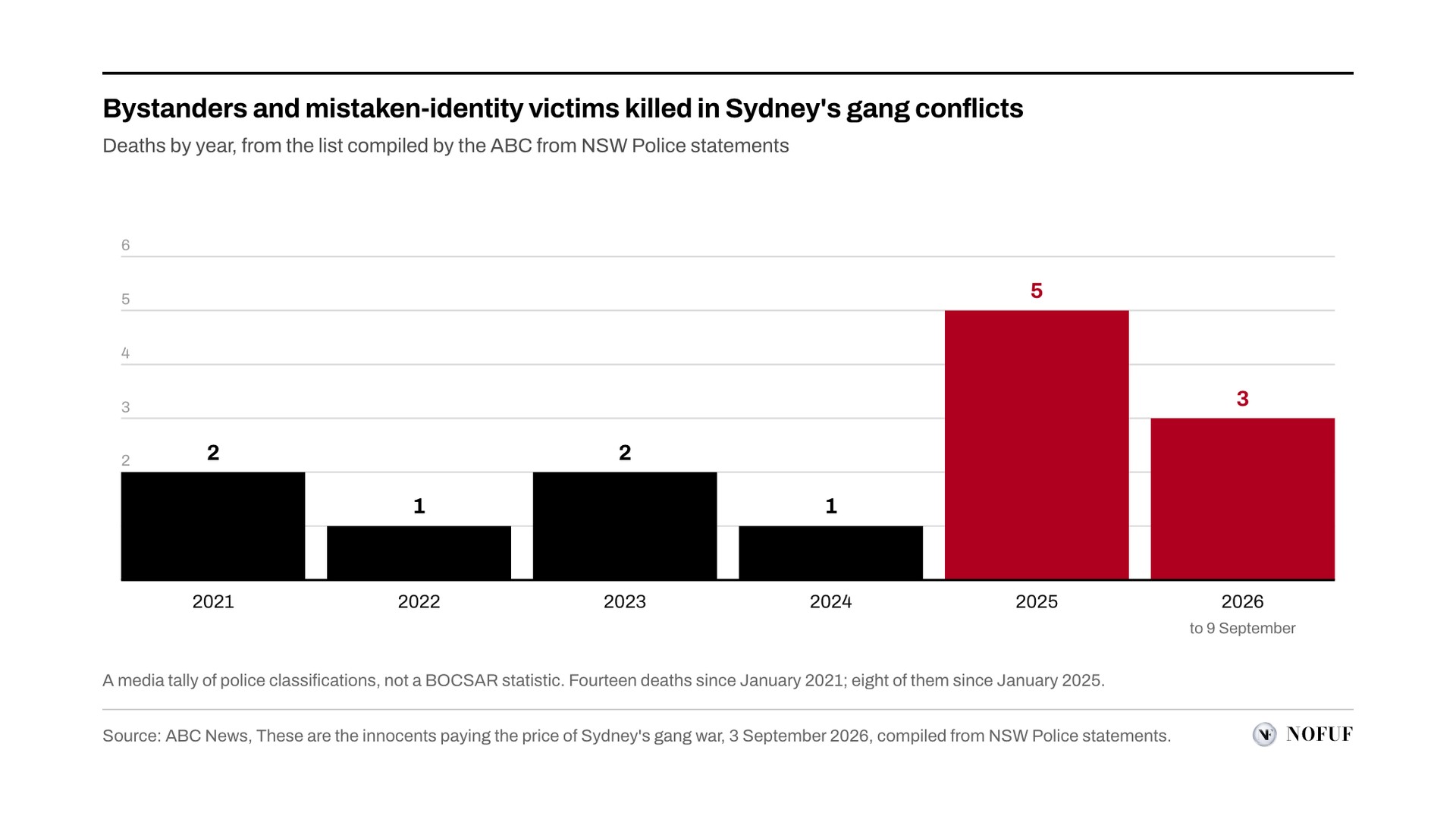
The organised-crime death toll is likewise a police classification compiled by journalists. The ABC counts Joshua Macdonald as the 41st murder attributed to underworld violence in Sydney since the current drug-trade conflicts began in 2020. Taskforce Falcon's Superintendent Jason Box said eight people had been murdered in mistaken-identity cases since 2021. The ABC's dated list, built from police statements, runs to fourteen deaths if bystanders and targeted family members are included. Nine of those fourteen fall since 1 January 2024. Eight fall since 1 January 2025.
Bystanders and mistaken-identity victims killed in Sydney's gang conflicts
Deaths by year, from the list compiled by the ABC from NSW Police statements
A media tally of police classifications, not a BOCSAR statistic. Fourteen deaths since January 2021; eight of them since January 2025.
Source: ABC News, These are the innocents paying the price of Sydney's gang war, 3 September 2026, compiled from NSW Police statements.
NOFUF
That list is the answer to the question the minister was actually asked. It reads, in order: Bol Deng, 20, Fairfield Heights, February 2024, killed in retribution for something he had not done. Kim Duncan, 65, Ambarvale, April 2025, caught in crossfire. Thi Kim Tran, Bankstown, April 2025, killed after her husband was targeted. John Versace, 23, Condell Park, May 2025, wrong house. Luke Manassa, 21, Pemulwuy, June 2025, mistaken identity. Gilbert Shino, 39, Glebe, August 2025, a friend was the target. Chris Baghsarian, 85, abducted from North Ryde and killed in February 2026, the wrong man. Marco Tapia, 23, Glen Alpine, 1 September 2026. Joshua Macdonald, 40, Merrylands West, 2 September 2026.
In the four years from 2021 to 2024, the same list contains six names. In the twenty months since, it contains eight. That is not a statistical trend in BOCSAR's sense; the numbers are too small for the test. It is a list of people, and it is getting longer faster.
What police say they have done
The government's answer to the list is an arrest count. Taskforce Falcon was stood up after the shooting of Dawood Zakaria in Granville in May 2025. NSW Police's written releases put its tally at 683 arrests and 1,727 charges on 29 July 2026, and 685 and 1,755 shortly after. The "more than 800" cited by the minister and by Superintendents Glasser and Box on 3 September is a broader twelve-month organised-crime figure, not the Falcon count in the releases. Both numbers are real; they measure different things, and the article uses the one that is written down.
What the arrest count does not show is what the arrests were for. As at August 2025, a single murder charge had come out of Falcon, against a 19-year-old over the Zakaria killing. The rest were, in the main, the offences that surround a shooting rather than the shooting itself. Police describe the shooters as juveniles recruited for small sums by people who are not in the country, and the pattern as "disorganised crime." Superintendent Box put it plainly: a high percentage of the offenders are juveniles lured by money. The minister called replacing them "Whack-A-Mole." Both were describing a supply of shooters that arrests do not reduce.
The wands
One instrument the government can point to with numbers attached is the knife-search power. Since 9 December 2024, police in NSW have been able to scan people with metal-detecting wands in designated areas without a warrant. BOCSAR's policing-activity data shows 5,002 people scanned in the twelve months to March 2025 and 42,818 in the twelve months to March 2026. Searches arising from a scan rose from 193 to 971. The first year's statutory review reported about 285 weapons detected. By mid-2026 the cumulative figures cited were 59,228 scans across 406 operations, 308 weapons seized, and 200 charges. A Bill introduced in June 2026 would make the power permanent and extend operations from twelve hours to twenty-four.
Those are real numbers about knives. They are not numbers about the shootings that prompted the press conference, and they should not be read as if they were.
Melbourne, where the argument does not arise
Across the border, no minister has had to say "not out of control," because the state's own agency has already said the opposite in its own way. The Crime Statistics Agency recorded 638,640 offences in Victoria in the year to June 2025, a rise of 15.7 per cent and the highest total since the agency began reporting in 2004. The year to March 2026 was fractionally lower, at 625,426. Deputy Commissioner Bob Hill's response to the June 2026 release was that overall crime "still remains far higher than both police and the community would like."
The shape of it is different from Sydney's. Victoria's homicide rate is flat or falling; The Conversation, citing CSA data, put it at 3.2 per 100,000 statewide, below the 2017 peak, and at a ten-year low in Melbourne itself. What is rising is the crime that happens inside people's houses and cars. Aggravated burglaries reached a record before easing 19.9 per cent in the year to March 2026, still about 23 per cent above three years earlier. Residential burglaries were 30,545 in the year to June 2025, up 13.9 per cent. Car thefts have doubled in four years.
And the people doing it are children. In the year to March 2026, alleged offenders aged 10 to 17 accounted for 48 per cent of aggravated burglaries, 49 per cent of home invasions, 55 per cent of carjackings and 60 per cent of robberies.
Share of alleged offenders aged 10 to 17, Victoria
Year to March 2026. Children are now the majority of alleged offenders in carjacking and robbery.
Source: Victorian Crime Statistics Agency, year ending March 2026, as released by Victoria Police on 18 June 2026.
NOFUF
Victoria Police's answer, like NSW's, is an arrest count: Operation Alliance, 1,300 gang-related arrests and 3,700 charges in a year; Operation Trinity, more than 5,000 stolen cars recovered in 2026 to date. The government's answer is the machete: a sales ban from 28 May 2025, the first in the country, and a possession ban from 1 September 2025, with a three-month amnesty at forty police stations. "Machetes are destroying lives so we will destroy machetes," the Premier, Jacinta Allan, said.
Petrol
Melbourne's organised-crime war is not being fought with pistols from the back seats of Audis. It is being fought with jerry cans.
Since 24 March 2023, arsonists working for rival illicit-tobacco syndicates have firebombed shops, warehouses and, occasionally, homes. Victoria Police confirmed 65 attacks by June 2024. AAP counted 105 by October 2024, by which time Taskforce Lunar had raided more than 200 shops, seized $37 million in cash, tobacco and vapes, and arrested 82 people. The running tally passed 130 by mid-2025 and 200 by early 2026.
Firebombings linked to Victoria's illicit tobacco trade
Running total since March 2023, at the four points where a count was published
Police and media tallies, not Crime Statistics Agency figures. One bystander death: Katie Tangey, 27, Truganina, 16 January 2025, at the wrong address.
Source: Victoria Police, June 2024; AAP, 9 October 2024; Taskforce Lunar updates, 2025; ABC News, 3 September 2026.
NOFUF
On 16 January 2025, Katie Tangey, 27, died when a townhouse in Truganina was set alight. Police believe the arsonists had the wrong address. A $500,000 reward stands and no one has been charged; the arson squad's Detective Inspector Chris Murray called the men responsible "faceless and gutless." Twelve days later, on 28 January 2025, Sam Abdulrahim, 32, was shot dead in the underground car park of a serviced-apartment block in Preston, in a killing the homicide squad investigated alongside Taskforce Lunar. The tobacco war has, on the public record, one bystander death and one gangland execution. It also has a Coalition MP standing up in September 2026 to say: "More than 200 firebombings since 2023, and at least one innocent Australian, Katie Tangey, dead."
Has this happened before
It has, and the comparison is instructive rather than comforting.
In 2012, "discharge firearm into premises" hit record monthly counts in April and July, and Sydney was described, then as now, as in the grip of a shooting epidemic. BOCSAR's own 2013 study found frequent fluctuation but no sustained increase in non-fatal shootings between 1995 and 2012. NSW Police's Operation Talon then cut shootings in its three priority areas by between 45 and 77 per cent over four years. The perception of a surge, in that instance, outran the official series, and the police response worked.
In 2003, Sydney confronted another wave of south-western shootings, pursued through Taskforce Gain and described at the time as a major political test for the government of the day. The precise annual counts from that operation have not been located in a primary police source reviewed for this article, so they are not used here as a benchmark.
What is different now is not the number of shootings. Police say it is who is holding the gun and who is on the other end of it. The shooter is younger, cheaper and further from the person who hired him. The victim, more often than at any point in the record, is someone who simply lived at the address.
The two claims, side by side
Yasmin Catley is right on the bureau's terms. NSW murder is "stable," the ten-year robbery trend is down, break-and-enter is down, and 685 people have been arrested by a taskforce that did not exist eighteen months ago. Kellie Sloane is right on the police's own terms. Forty-one underworld murders since 2020, fifty-one shootings this year on the only count that exists, and eight people dead since January 2025 who were never the target. Both women are describing NSW in September 2026 and neither is misquoting the record.
What the record will not do is settle the word. "Control" is not a statistical category, and the agencies that publish the numbers are careful never to use it. The next official quarter, covering July to September 2026, will be published by BOCSAR in December. It will be the first to contain Marco Tapia and Joshua Macdonald. Until then, the only place they appear in the state's record is a police media release and a list kept by journalists, which is where every one of the fourteen names before them started too.
Do you have information about this matter? NOFUF welcomes documents, records and first-hand accounts that may assist its reporting. All information and source identities will be treated as confidential.
Right of reply
No private individual is accused in this piece. Figures are drawn from NSW Police statements, Bureau of Crime Statistics and Research data and published reporting. No right of reply was sought.
Sources17
- Recorded Crime Statistics quarterly report, twelve months to March 2026, murder victims and trend classification. NSW Bureau of Crime Statistics and Research, 1 June 2026.
- Recorded Crime Statistics, calendar 2024, murder victims 85, statement by executive director Jackie Fitzgerald. NSW Bureau of Crime Statistics and Research, 1 March 2025.
- Press conference, NSW Police Minister Yasmin Catley, Acting Premier Prue Car and Superintendents Simon Glasser and Jason Box, 3 September 2026. NSW Government, 3 September 2026.
- Statement by the Opposition Leader, Kellie Sloane, on organised crime in Sydney. NSW Opposition, 3 September 2026.
- These are the innocents paying the price of Sydney's gang war, dated list compiled from NSW Police statements. ABC News, 3 September 2026.
- Public-place shootings in NSW, 2026 tally of 51 to 2 September. Nine News, 2 September 2026.
- Taskforce Falcon media releases, 683 arrests and 1,727 charges, 29 July 2026, and 685 and 1,755 shortly after. NSW Police Force, 29 July 2026.
- Policing activity data, wanding scans and searches, twelve months to March 2025 and March 2026. NSW Bureau of Crime Statistics and Research, 1 June 2026.
- Statutory review of the knife wanding powers, first year, and the Bill introduced June 2026. NSW Government, 1 June 2026.
- Recorded offences, year ending June 2025 and year ending March 2026. Crime Statistics Agency Victoria, 18 June 2026.
- Statement by Deputy Commissioner Bob Hill on the March 2026 release; Operation Alliance and Operation Trinity tallies. Victoria Police, 18 June 2026.
- Victoria's homicide rate, 3.2 per 100,000, citing CSA data. The Conversation.
- Illicit tobacco arson attacks, 65 confirmed by June 2024; 105 counted by 9 October 2024; Taskforce Lunar raids, seizures and arrests. Victoria Police and AAP, 9 October 2024.
- Katie Tangey, Truganina, 16 January 2025; reward and statement by Detective Inspector Chris Murray. Victoria Police, 16 January 2025.
- Machete sales ban from 28 May 2025 and possession ban from 1 September 2025; statement by the Premier. Victorian Government, 28 May 2025.
- Firearm discharge offences and non-fatal shootings in NSW, 1995 to 2012. NSW Bureau of Crime Statistics and Research, 1 January 2013.
- Operation Talon results, reduction in shootings in priority areas. NSW Police Force.
Disclosure
None.
More on Crime
- $1 Million Cash, Vacuum-Sealed Bags
10 October 2026
- A Construction Business as a Laundry: The Killara Charge Inside the $150 Million Case
10 October 2026
- The Dubai Scam Bust
10 September 2026
- Underground Banks
6 September 2026