



Crime
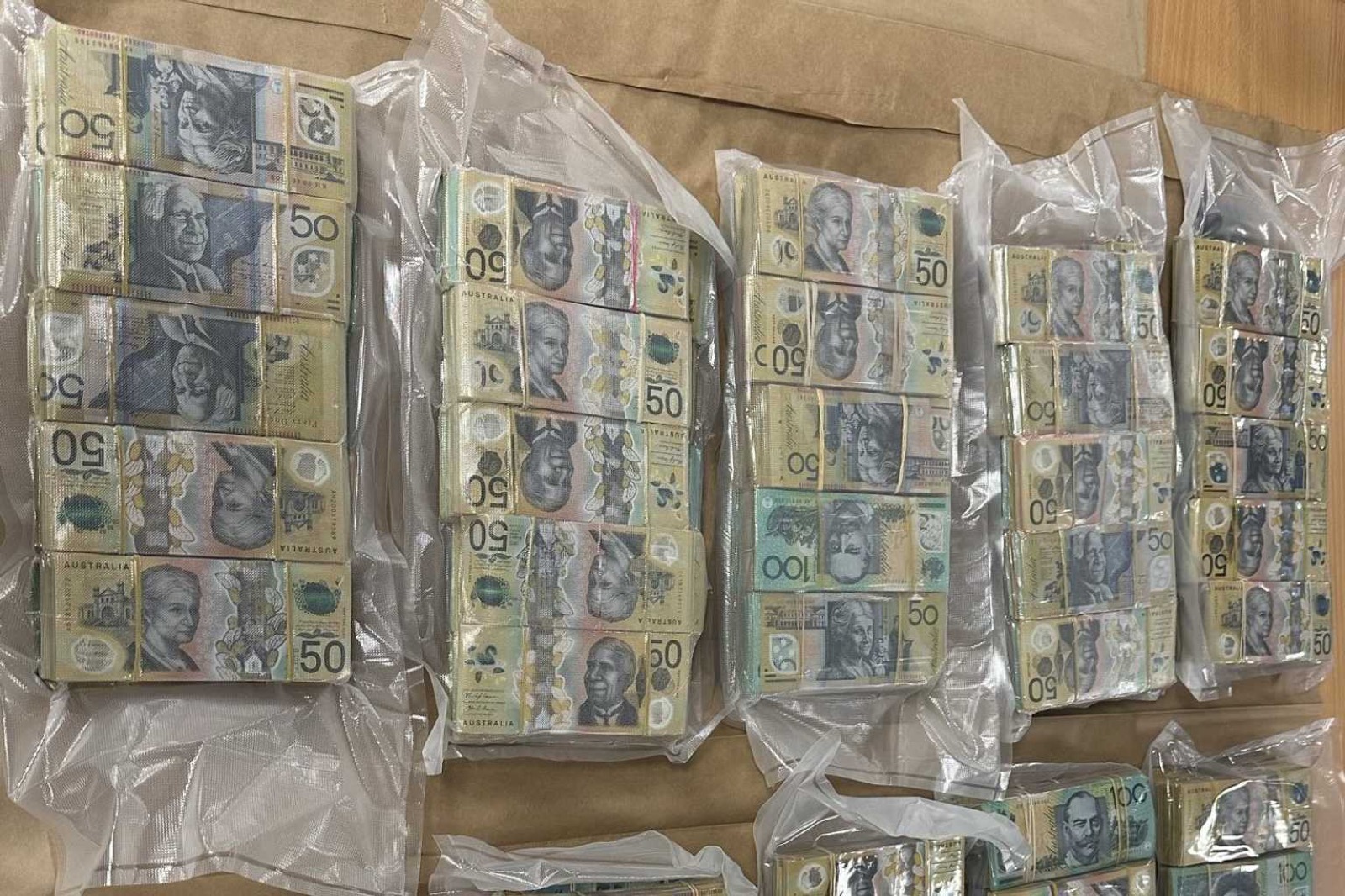
$1 Million Cash, Vacuum-Sealed Bags
Stephen Ronald Sonners, 58, was stopped at Triabunna in September 2025 with $1,065,660 in a cardboard box, told police he found it under a bridge, and later admitted he was being paid about $1,000 to leave it in the bush. The Supreme Court of Tasmania gave him fifteen months' home detention. The judge's published reasons explain the charge, the defence he did not run, and the encrypted group chat called Final pass.
By T. Nguyen
10 October 2026 · 4 min read
At half past eight on the evening of 20 September 2025, East Coast police stopped a white Holden Rodeo on the Tasman Highway at Triabunna for a random breath test., The driver blew zero. He was, however, disqualified from driving, which kept the officer at the window long enough to notice a large cardboard box on the passenger seat and the smell of cannabis.
The driver said the box held paperwork. It held $1,065,660 in cash: loose notes, and ten bundles vacuum-sealed at $100,000 each, one of them marked "100K" with a smiley face. Beside it were three Google Pixel phones and a snap-lock bag of cannabis.
The driver was Stephen Ronald Sonners, a 58-year-old self-employed painter from Mayfield, a former soldier with no relevant prior convictions. On 18 September 2026, Justice Stephen Estcourt of the Supreme Court of Tasmania sentenced him to fifteen months' home detention for dealing with property suspected of being the proceeds of crime. The judge's reasons, published by the court, are the source for most of what follows.
The story, and the real one
In his police interview Sonners said he had found the box under a bridge. He later admitted that was false.
What he then told police, and what the court accepted, was this. He had picked the box up from a man known as Blade at the Sorell Bowls Club and Community Centre. He was to drive it to Falmouth, on the east coast, and leave it in the bush near the beach. He was to be paid $1,000 to $2,000 for the run, money he needed to pay off debts. He said he was involved with the Nomads motorcycle club, that he presumed the cash was linked to criminal activity, and that he was now afraid for his safety because the money had been lost to the people it belonged to.
He said he did not know how much was in the box and was shocked when police told him.
Final pass
One of the three phones opened a window on the people behind the box. It carried messages on Threema, an encrypted application the judge noted is commonly used by organised crime groups. A group chat called "Final pass" had been created the day before the stop. Its members went by Scout, which the court was told was Sonners, and by Neptune, Capo, Blade and Cerus, the last of them the chat's creator. The chat held instructions on where to deliver the money and warnings about police presence.
The State's case was that Sonners was collecting money from the sale of controlled substances and delivering it. Tasmania Police had said as much the morning after the arrest: the cash, it would allege, was profit from the sale of illicit drugs in Tasmania.
Why the sentence was small
A million dollars in drug money and fifteen months at home, with an ankle monitor, reads as lenient. The judge's reasons explain why it was not open to him to treat it as more.
Sonners was charged under section 66B of Tasmania's Crime (Confiscation of Profits) Act, which makes it an offence to deal with property where there are reasonable grounds to suspect it is the proceeds of crime. The maximum penalty is two years. Possessing the property counts as dealing with it.
The section carries a defence: a defendant who satisfies the court that he had no reasonable grounds to suspect the property came from crime is not guilty. Sonners did not try to run it. But the judge was careful about the other direction too. Sonners was not to be sentenced, he said, "on the basis that he knew or believed that the money constituted proceeds of crime." If knowledge, or even recklessness, had been established, "he would be guilty of a more serious offence with a higher maximum penalty."
That is the shape of the case. The State charged the offence it could prove, suspicion rather than knowledge, and the sentence followed the charge. A man who says he presumed the money was criminal, drove it anyway for a thousand dollars, and lied about a bridge, was dealt with as a courier who should have known, not as a launderer who did.
He had spent sixteen days in custody before bail in October 2025, indicated a guilty plea in April 2026, and came to court with a pre-sentence report that found his home suitable for electronic monitoring and recorded that he had distanced himself from what it called pro-criminal associates. The order confines him to that home for fifteen months except with a probation officer's approval, bars alcohol and illicit drugs, and lets police enter and search at any time.
What the box says about the trade
The detail worth keeping is the packaging. Ten bundles of $100,000, vacuum-sealed, one of them labelled by hand. That is not how a person stores savings. It is how a business counts stock: in round units, sealed against damp and dogs, marked so the next hand down the line can check the count without opening it.
Whoever packed that box had done it before, had a scale and a machine, and had enough of it moving that a million dollars could be entrusted to a painter with a driving disqualification for the price of a used fridge. The court was not asked to decide who they were. Scout went home with a monitor on his ankle. Neptune, Capo, Blade and Cerus are names in a chat.
Do you have information about this matter? NOFUF welcomes documents, records and first-hand accounts that may assist its reporting. All information and source identities will be treated as confidential.
Right of reply
The article reports the published reasons of the Supreme Court of Tasmania and a Tasmania Police media release. Mr Sonners was convicted on his own plea and is named in the court's published sentence. No right of reply was sought.
Sources4
- Comments on passing sentence, Tasmania v Sonners, S R, Estcourt J. Supreme Court of Tasmania, 18 September 2026. Open the document
- Media release, Man charged with dealing with property suspected of being the proceeds of crime. Tasmania Police, 21 September 2025. Open the document
- Crime (Confiscation of Profits) Act 1993 (Tas), section 66B, dealing with property suspected of being proceeds of crime. State of Tasmania.
- Sentencing Act 1997 (Tas), Part 5A, home detention orders. State of Tasmania.
Disclosure
None. No person or company referred to in this article has any connection to NOFUF or its editor.
More on Crime
- A Construction Business as a Laundry: The Killara Charge Inside the $150 Million Case
10 October 2026
- The Dubai Scam Bust
10 September 2026
- Is Sydney's Gangland Violence Out of Control?
9 September 2026
- Underground Banks
6 September 2026