



Crime
Underground Banks
Operation Avarus-Midas, in the AFP's own words: how an alleged unregulated bank moved criminal money without a dollar crossing a border.
In February 2023 the Australian Federal Police arrested nine people and restrained more than twenty Sydney properties over what they called an unregulated multinational bank. The police set out the mechanism themselves. Every entity in it was an ordinary registered company.
By B. O'Connell
6 September 2026 · 4 min read
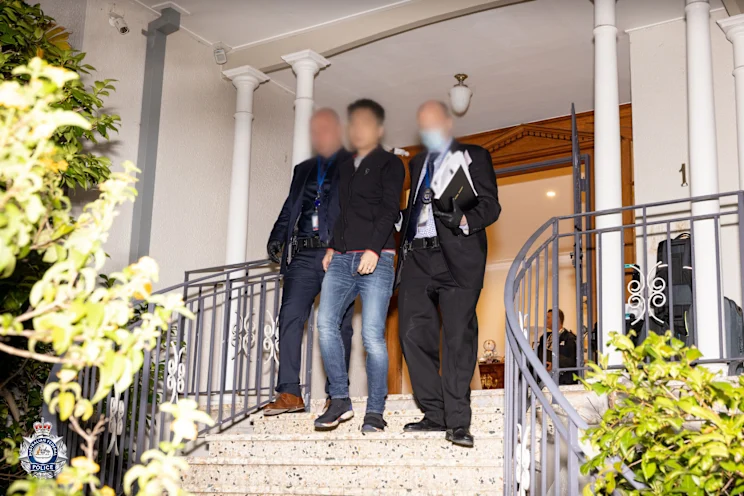
On the morning of 1 February 2023, Australian Federal Police officers arrested a 43-year-old man at his home in Vaucluse, on Sydney's eastern harbour. By the end of the day they had arrested seven more people across the city, served a court attendance notice on a 69-year-old woman in Burwood, executed search warrants at thirteen addresses, and seized $29 million in cryptocurrency, eighteen designer watches, seventeen designer handbags, at least 46 pieces of jewellery and four licensed firearms that had not been stored lawfully.
The AFP alleged that the Vaucluse man had founded and directed an organisation that operated, in the police's phrase, as an unregulated multinational bank. Its clients, the AFP said, were criminal groups in Australia and overseas who needed their money to look as though it had passed through the legitimate financial system. Its founders, the police alleged, had made more than $150 million for themselves between 2018 and 2022 doing it.
The investigation was called Operation Avarus-Midas. Assistant Commissioner Kirsty Schofield described it to reporters as among the largest and most complex money laundering investigations the AFP had run. It is also, for anyone trying to understand how illicit money moves through Australia, one of the clearest explanations the police have ever published, because the AFP set out the mechanism step by step in its own media release.
The mechanism
The scheme, as the AFP described it, depended on a legal problem that has nothing to do with crime. China restricts how much money its citizens can move out of the country. A person in Australia with legitimate funds in a Chinese bank account, who wants to buy a house in Sydney, cannot simply transfer the money.
The alleged organisation offered a solution. The buyer approached a broker in Australia, who was in fact an unregistered money remitter working for the organisation. The organisation supplied the buyer with cash in Australia, charging a fee of up to ten per cent. The buyer bought the house. In return, the buyer transferred the equivalent amount, plus the fee, from their own Chinese bank account to an account in China controlled by the organisation.
That is the first half. The second half is where the crime was alleged to be.
The cash the organisation handed to the buyer in Australia was, according to police, criminal money: the proceeds of drug trafficking and other offences, collected from organised crime groups who needed it cleaned. Those groups were paid back, the AFP alleged, from the funds arriving in the organisation's Chinese accounts, routed through shell companies in several jurisdictions. The property buyer in Sydney got their house. The criminal group got clean money offshore. The organisation kept the fee, and, the AFP alleged, invested it in Sydney real estate.
No money crossed a border. That was the point. The Australian cash stayed in Australia, the Chinese money stayed in China, and the two ledgers were reconciled privately, by an organisation that answered to no regulator. The AFP said the group also used daigou networks, casino junkets and informal value transfer systems to the same end.
What the police took
The AFP-led Criminal Assets Confiscation Taskforce obtained restraining orders under the Proceeds of Crime Act over more than twenty Sydney properties, including several commercial buildings in and around the CBD, two houses in the eastern suburbs worth more than $19 million together, and a 360-hectare block near the site of the Western Sydney airport valued at $47 million. The orders also covered 66 bank accounts, cash, and more than $1 million in vehicles.
A restraining order is not a confiscation. It freezes the asset so it cannot be sold or moved while the criminal case and any forfeiture proceedings run. Whether the assets are ultimately forfeited depends on what the courts decide. As of October 2026, NOFUF has found no published forfeiture order over any of the restrained property; the restraining orders of February 2023 remain the last public step.
The bank that noticed
The AFP publicly thanked one private company for its assistance: National Australia Bank. The ABC reported that the AFP worked with AUSTRAC, National Australia Bank and overseas law enforcement agencies during the investigation.
Under Australia's anti-money laundering law, banks must report suspicious matters to AUSTRAC, the financial intelligence agency, and AUSTRAC was a partner in the operation. The case is an example of the system working the way it is designed to: a bank's compliance team flags an account, the intelligence reaches police, and police follow it back to the people behind it.
The charges
The 43-year-old Vaucluse man was charged with two offences: conspiracy to deal with money worth $1 million or more intending it to become an instrument of crime, and conspiracy to deal in the proceeds of general crime worth $1 million or more. Each carries a maximum of 25 years' imprisonment. Six others were charged with one or other of those offences. A 56-year-old Yagoona man was charged with aiding and abetting an offence and with perverting the course of justice, each carrying five years.
Every charge was an allegation. The accused were entitled to the presumption of innocence, and the AFP's statements were, as the police themselves put it, matters that "will be alleged."
Since the arrests
As of October 2026, NOFUF has found no public record of a plea, trial, sentence, acquittal or discontinuance for any of the nine. The AFP, which announced the arrests, has published nothing further on the operation, and the courts' lists are not searchable by operation name. The charges remain allegations. Each of the accused is presumed innocent, and nothing in this article should be read as suggesting otherwise. NOFUF will update this article when the public record changes.
Australian money laundering systems
The register will tell you a company exists, who its director is, and where it is registered. It will not tell you what passes through its account. Avarus-Midas is a case in which the gap between those two things was, on the AFP's allegation, $150 million wide.
Do you have information about this matter? NOFUF welcomes documents, records and first-hand accounts that may assist its reporting. All information and source identities will be treated as confidential.
Right of reply
The matters described are allegations before the courts, taken from the Australian Federal Police's published statements and court reporting. The accused are presumed innocent. No right of reply was sought.
Sources5
- Media release, Property and cash restrained as alleged money laundering group charged. Australian Federal Police, 2 February 2023. Open the document
- Nine arrested, Sydney homes seized, as police crush underground bank. ABC News, 2 February 2023. Open the document
- Restraining orders under the Proceeds of Crime Act 2002 (Cth), Criminal Assets Confiscation Taskforce. Australian Federal Police, 1 February 2023.
- Anti-Money Laundering and Counter-Terrorism Financing Act 2006 (Cth), suspicious matter reporting. Commonwealth of Australia.
- The Xin money laundering syndicate: how a shadow bank washed $10 billion (source of the lead photograph). First AML. Open the document
Disclosure
None. No person or company named in this article has any connection to NOFUF or its editor.
More on Crime
- $1 Million Cash, Vacuum-Sealed Bags
10 October 2026
- A Construction Business as a Laundry: The Killara Charge Inside the $150 Million Case
10 October 2026
- The Dubai Scam Bust
10 September 2026
- Is Sydney's Gangland Violence Out of Control?
9 September 2026